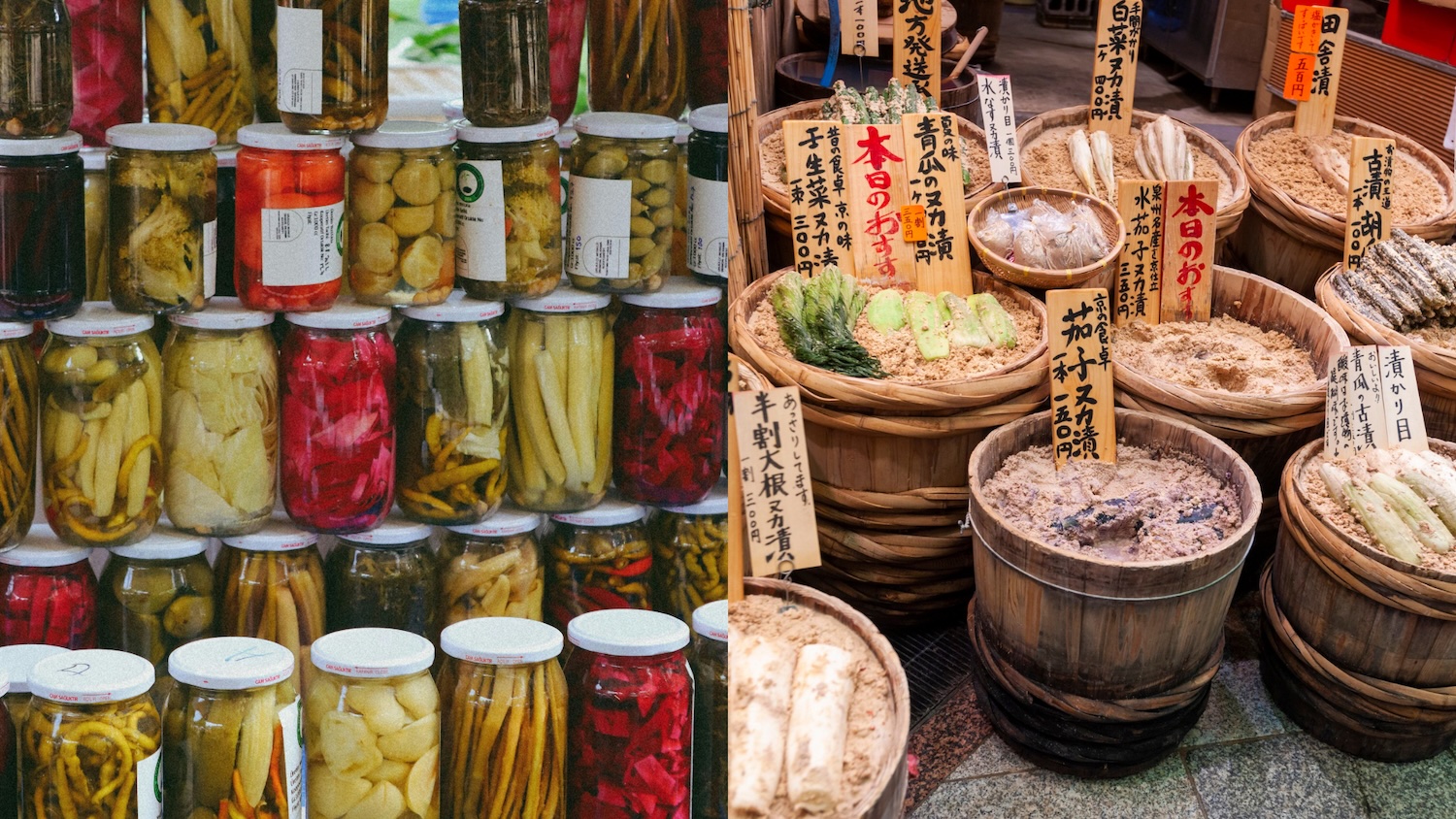
Today, many pickles—both in Japan and in Western countries—are prepared quickly with vinegar. These do not rely on lactic fermentation. Here, we focus on traditional pickles shaped by lactic fermentation, where microbial activity and time continue to influence flavor.
Japanese pickles and Western pickles are often grouped together under lactic fermentation, and microbiologically this is correct. Both are classic lactic fermentation products. Yet differences appear when we look at how these foods function within a meal.
This article explores lactic fermentation as a shared process shaped by distinct cultural table structures, revealing how the same technique leads to different roles and meanings.
For a closer look at Japanese pickles themselves—their varieties and history—you can read our introduction to tsukemono: What Is Tsukemono, Japanese Pickles?
What Is Lactic Fermentation? A Shared Process with Different Intentions
Lactic fermentation is a process in which lactic acid bacteria convert sugars into lactic acid. As acidity increases, the environment becomes hostile to unwanted microbes, allowing food to be preserved while developing distinctive flavors.
This lactic fermentation process appears across cultures. It is found in vegetables, dairy, grains, and beverages, making it one of the most widespread lactic fermentation examples in the world.
From a biological perspective, Japanese pickles and Western pickles follow the same fundamental rule. However, fermentation is always shaped by its context. The intention behind fermentation—why it is used and how it is managed—shapes the final result just as much as the microbes themselves.
Lactic Fermentation Products in Different Cultures
Across cultures, lactic fermentation products developed primarily as methods of preservation. In both Japan and the West, vegetables are salted to create conditions favorable for lactic acid bacteria, lowering pH and extending shelf life. As fermentation progresses, flavor, texture, and aroma evolve over time. This gradual transformation is a shared characteristic of lactic fermentation.
Historically, both regions relied on reusable fermentation vessels such as wooden barrels, ceramic crocks, and other locally available containers, although specific materials and construction methods varied by region and period. These vessels were shaped by climate, craftsmanship, and available resources. At the same time, container materials can influence microbial communities and, in some cases, contribute subtly to flavor development through resident microflora and oxygen permeability.
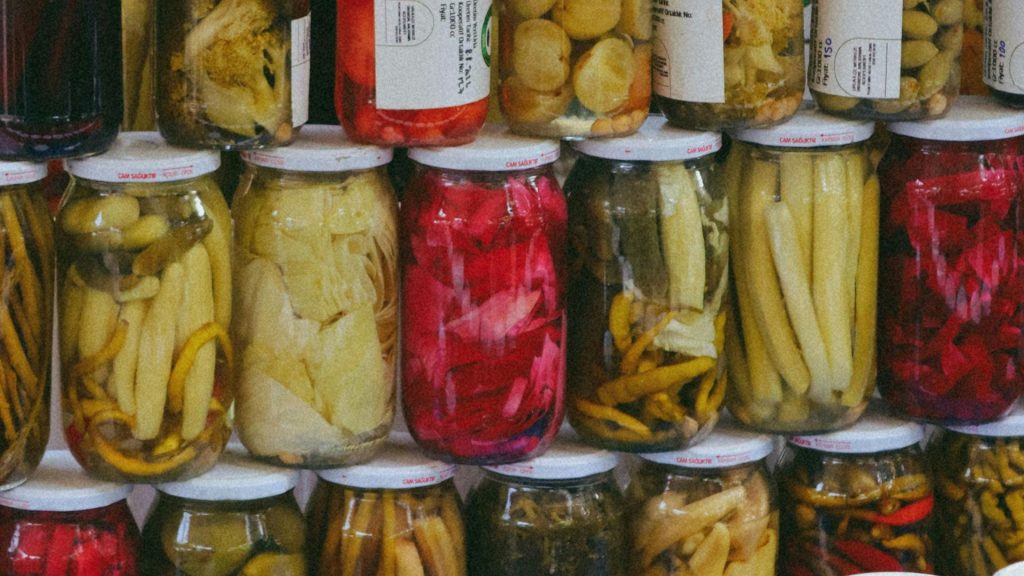
In contemporary everyday practice, visible differences are more noticeable. In many Western households, fermented vegetables such as sauerkraut or brined cucumbers are commonly prepared or stored in glass jars, ceramic crocks, or food-safe containers once fermentation reaches a preferred stage.
In Japan, while some traditional producers continue to use wooden barrels, many households maintain rice-bran fermentation beds (nukadoko) inside plastic, ceramic, or wooden containers. In these cases, the fermentation medium itself—such as rice bran mixed with salt and water—plays a central role, while the container functions primarily as structural support.
The distinction, therefore, is not rooted in fundamentally different fermentation biology. In both Japan and the West, the lactic fermentation process unfolds through similar microbial mechanisms and continues to evolve gradually over time. Differences become more visible in patterns of serving and meal structure.
In many Japanese meals centered around rice, small portions of pickles are eaten repeatedly throughout the meal. In many Western contexts, fermented vegetables are more often presented as one component within a composed plate or dish. The biological process remains comparable, yet its culinary placement and rhythm within a meal can differ.
Lactic Fermentation Systems: Patterns of Management
Lactic fermentation in both Japanese and Western pickles depends on conditions in which lactic acid bacteria become dominant. While oxygen may be present at certain stages—especially during preparation or mixing—the fermentation environment is structured so that low-oxygen conditions gradually prevail, allowing acid-producing bacteria to stabilize the system.
The difference between traditions is less about oxygen itself and more about patterns of management.
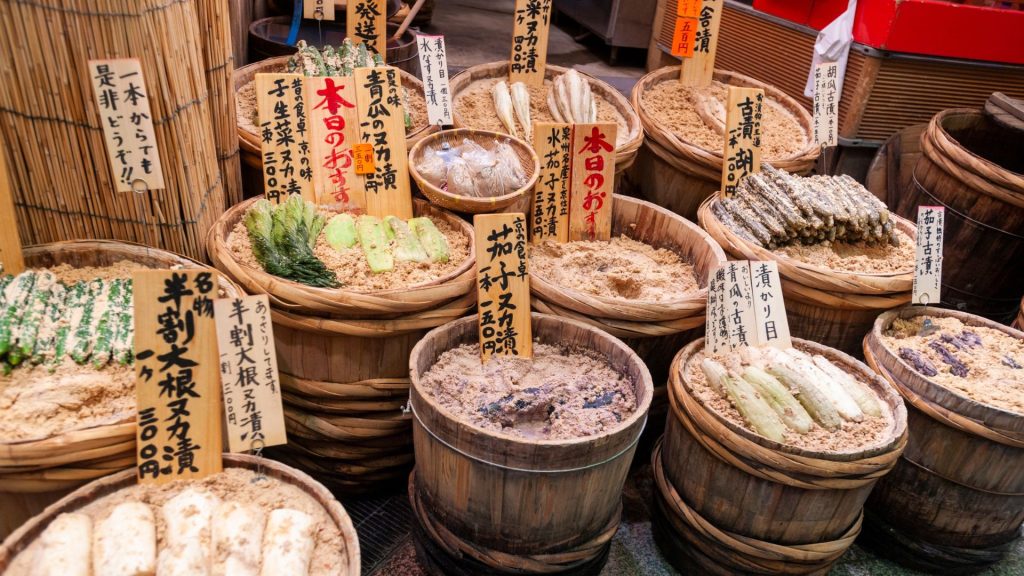
In Japanese practices such as nukadoko, vegetables are placed within a fermentation bed made of rice bran, salt, and water. The bed is mixed regularly, introducing brief exposure to air while maintaining an overall environment in which lactic acid bacteria remain dominant. Daily care—stirring, adjusting salt levels, monitoring aroma—forms part of the fermentation process itself.
In many Western traditions, vegetables are submerged in salt brine and weighted beneath the surface of the liquid. As carbon dioxide accumulates and oxygen is displaced, the environment becomes increasingly anaerobic. Once a preferred acidity is reached, the vegetables are typically stored in sealed jars, crocks, or barrels to maintain relative stability. Intervention after this stage is generally minimal.
Both systems rely on similar microbial principles. What differs is the rhythm of human involvement: one incorporates ongoing tactile engagement as part of everyday maintenance, while the other often emphasizes creating stable conditions and then preserving them.
At 耀 Hikari, this distinction is expressed simply: fermentation is not something to force into exact control, but something whose conditions are prepared carefully and then observed over time.
Lactic Fermentation as Design: What Pickles Reveal About Food Culture
Lactic fermentation is a shared preservation method in both Japan and the West. The microbial process is similar, and flavor continues to evolve over time in both traditions. What differs is how these fermented foods are positioned within a meal.
In many Japanese meals, pickles are eaten in small portions alongside rice. In many Western contexts, fermented vegetables appear as one component within a composed dish. The biological process remains comparable, yet its culinary role shifts with meal structure.
For those who wish to explore Japanese lactic fermentation more deeply, our cooking study programs offer structured immersion in fermentation thinking, while our newsletter shares ongoing reflections on Japanese food culture.
No responses yet