Japanese food is often introduced through individual dishes. Yet beneath those dishes lies a quieter logic that shapes how flavor is built, balanced, and carried across many forms.
That logic is rice fermentation—a structure that quietly connects many forms of Japanese food.
In Japan, fermentation is organized around rice—not as a single tradition, but as a shared structure. Understanding rice fermentation allows sake, mirin, miso, soy sauce, amazake, and rice vinegar to be seen not as separate foods, but as variations within one system.
This article explains rice fermentation as that system: how it works, why it matters, and how it connects the core of Japanese fermented foods.
What Is Rice Fermentation?
Rice fermentation refers to fermentation processes that use rice as their primary carbohydrate base. However, rice does not ferment on its own. Rice contains very little sugar. Instead, it is composed mainly of starch, which cannot be directly fermented by yeast or bacteria. For fermentation to occur, that starch must first be converted into sugars.
This is the defining feature of rice fermentation in Japan. Fermentation is never the first step—it is always preceded by conversion. Because of this, rice fermentation is not a single reaction but a structured process, designed in stages rather than left to spontaneous change.
From Starch to Fermentation: The Role of Saccharification
The key step that enables rice fermentation is saccharification—the conversion of starch into sugar.
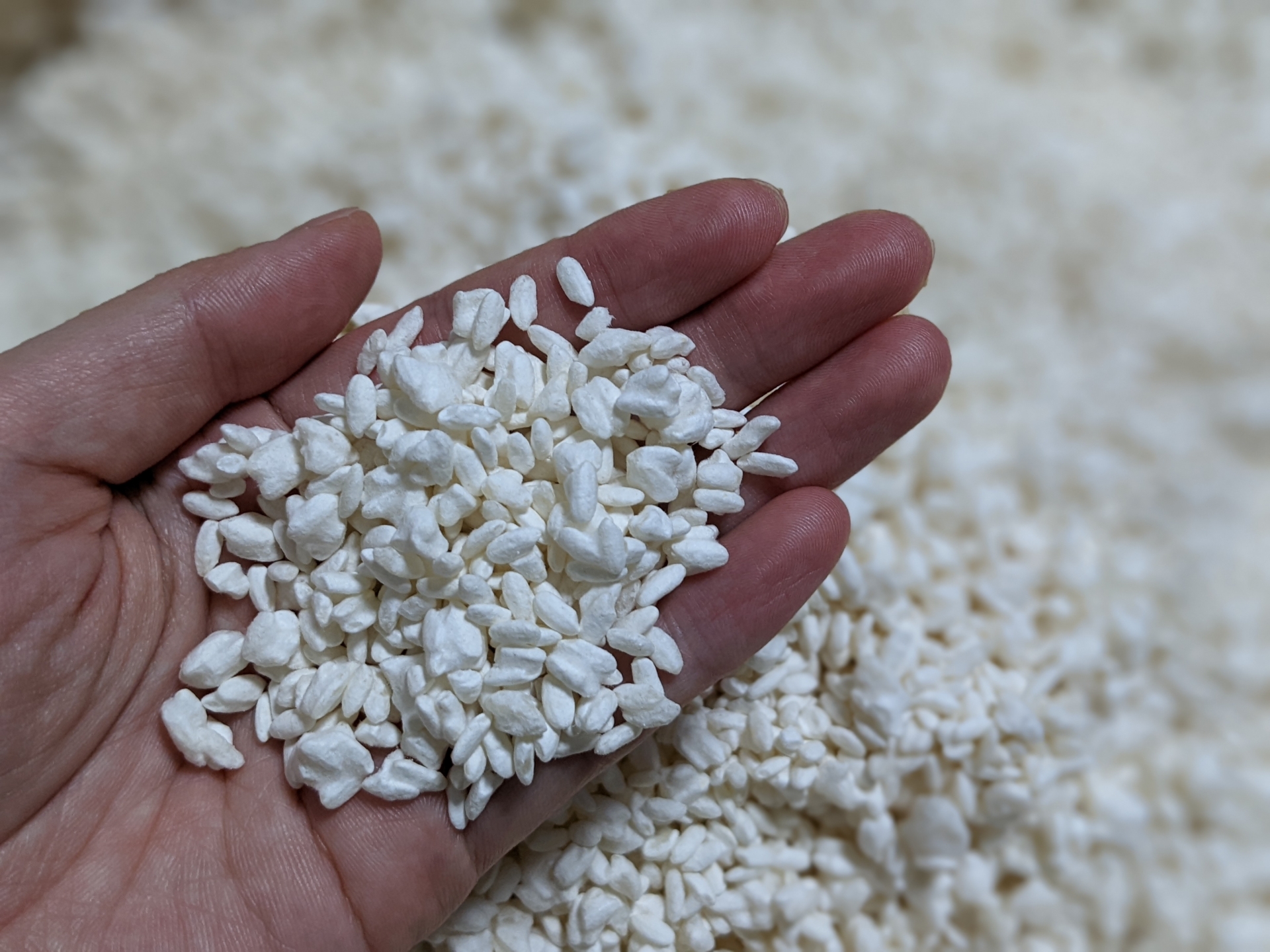
In Japanese fermentation, this role is most commonly carried by koji, rice cultivated with specific molds, a key element in Japanese fermentation, that produce enzymes. These enzymes break starch down into fermentable sugars. Koji itself does not ferment food. Instead, it prepares food so that fermentation can occur.
This separation between conversion and fermentation is critical. Because saccharification happens first, fermentation can be guided, paused, or redirected depending on the desired outcome. Sweetness can be preserved. Alcohol can be developed. Acidity can be pursued further.
This is why rice fermentation supports such a wide range of foods while remaining structurally coherent.
Rice Fermentation in Japanese Foods and Seasonings
Rice fermentation appears throughout Japanese cooking in different forms. Rather than defining each food in detail, the following examples show how rice fermentation functions within the system, with links to deeper explanations.
Rice Fermentation as a Starting Point: Sake
Sake represents one of the most direct expressions of rice fermentation. Rice starch is converted into sugar, which is then fermented into alcohol without interruption. As a result, sake often serves as a reference point for understanding the basic structure of rice fermentation.
Rice Fermentation as Sweetened Alcohol: Mirin
Mirin follows a fermentation pathway related to sake, but it is guided toward retaining sweetness. Historically, it began as a drink, and from the late Edo period it gradually became used mainly as a seasoning—though some people still drink it today. In cooking, mirin adds sweetness, depth, and balance, often softening sharp edges rather than emphasizing them.
Rice Fermentation Supporting Umami: Miso and Soy Sauce
In miso and soy sauce, rice fermentation plays a supporting role. Rice, through koji, provides enzymes that enable the fermentation of soybeans.
Here, rice is not the main ingredient, but it remains essential to the process. This structure explains why miso and soy sauce are inseparable from rice fermentation, even though they are not rice foods themselves.
Rice Fermentation Without Alcohol: Amazake (Rice Fermented Drink)
Amazake is often described as a rice fermented drink, but structurally it highlights a different choice. In amazake, fermentation is guided so that saccharification occurs while alcohol production is minimized or avoided. The process is stopped early, allowing natural sweetness to remain.
Because of this, amazake shows that rice fermentation is not defined by alcohol, but by where the process is intentionally paused.
Rice Fermentation Taken Further: Rice Vinegar
Rice vinegar represents an extension of rice fermentation beyond alcohol. After sake-like fermentation produces alcohol, a second transformation converts that alcohol into acetic acid. Time and exposure deepen acidity, creating a seasoning that sits at the far end of the fermentation sequence.
How Rice Fermentation Connects Japanese Fermented Foods
Japanese fermented foods can appear very different on the surface. Some are alcoholic, others sweet, savory, or acidic. What connects them is rice fermentation.
At the core is a shared structure: rice starch is first converted into sugar, and fermentation follows. Because these steps are separated, the process can be guided rather than rushed.
This is why rice fermentation produces such varied results. Alcohol, sweetness, umami, and acidity are not separate traditions, but outcomes shaped by how far the process is allowed to continue—or where it is intentionally paused. Seen through this structure, sake, mirin, miso, soy sauce, amazake, and rice vinegar align as variations within a single framework.
Rice Fermentation as the Backbone of Japanese Fermented Foods
Understanding rice fermentation removes the need to memorize individual foods or rules. It offers a way to see Japanese fermented foods through structure rather than surface.
This perspective did not emerge from theory alone. It formed gradually, through observation, tasting, and time. We explore these ways of seeing further in our Journal, where we write not to instruct, but to observe how fermentation quietly shapes Japanese food culture.
For those who wish to continue exploring rice fermentation, we also share ongoing insights through our newsletter and seasonal fermentation experiences in Japan.
No responses yet