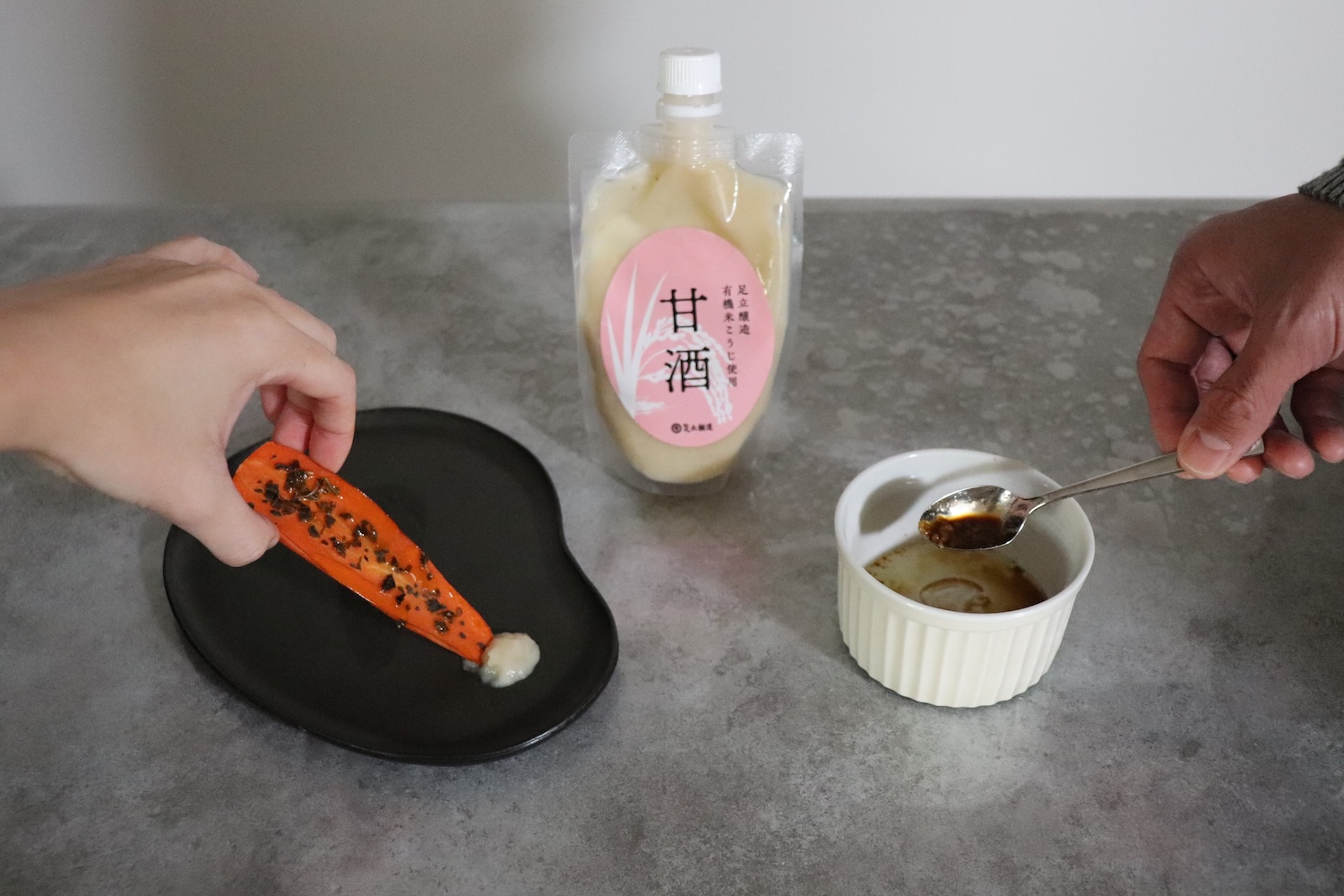
A quiet observation of how amazake shifts its place in a dish—without disappearing.
Amazake is often introduced as a gentle sweetness. Especially in contemporary cooking, it tends to be framed as a substitute for sugar or syrup—something mild, rounded, and supportive.
Because amazake is non alcoholic, it is frequently described in functional terms: safe, versatile, easy to use.
Yet in actual dishes, amazake is rarely pointed at directly.
It is present, but not always named.
Felt, but not always identified.
This Journal does not explain what amazake does, nor how it should be used. Instead, it records what was observed when the same amazake was placed in two different temperature conditions—and how its position seemed to shift.
Koji Amazake Is Often Seen as Sweetness
Before comparing conditions, it is important to acknowledge how amazake is commonly perceived.
In many dishes, amazake is seen primarily as sweetness.
It is noticed as something that softens edges, rounds flavors, or supports other ingredients. Rarely does it announce itself. Even when amazake is present, attention often moves past it, toward more dominant elements.
This way of seeing amazake is especially common when discussing amazake non alcoholic cooking. The conversation tends to focus on what it replaces or improves, rather than how it appears.
This section does not define amazake, evaluate it, or assign it a role. It simply sets a shared starting point: amazake is often seen as sweetness, and not much more.
The Same Amazake, in Two Temperatures
To observe more closely, the conditions were kept consistent.
The same amazake was used throughout.
The amount remained the same.
The intention of the dish did not change.
Only one condition differed.
In one case, amazake was used before heat was introduced.
In the other, amazake was added after the dish had already become warm.
No explanation is offered here. This section exists only to clarify that what follows is a comparison of placement, not of ingredients.
Koji Amazake, Before Heat, in a Dressing
In this observation, amazake was combined with olive oil and soy sauce to form a simple dressing.
No heat was introduced at any stage.
When used this way, the presence of koji itself was difficult to identify. Rather than appearing as a distinct element, amazake seemed to spread across the dish, sweetening the whole without drawing attention to itself.
It did not arrive early, nor did it hold a clear contour. Instead, it felt evenly distributed—present as an overall impression rather than as something that could be pointed to.
In this condition, amazake did not stand out as “koji.” It functioned quietly within the dressing, without separating itself from the other components.
Koji Amazake, After the Dish Was Warm
In the second observation, the same dressing—olive oil and soy sauce—was first applied to carrots, which were then roasted in the oven until warm. Only after the dish had been fully heated was amazake added and gently coated over the vegetables.
Here, the amazake did not feel integrated into the dish in the same way. Its presence was closer to how it tasted on its own, before being mixed into a preparation.
The warmth of the dish did not seem to change the character of the amazake itself. Without sufficient temperature change within the amazake, its expression remained similar to its unheated state.
As part of the dish, this created a different experience. Rather than blending into the whole, amazake behaved more like an accompanying element—something that could be tasted separately, almost like a sauce added for variation.
This was not perceived as better or worse.
It was simply a different position within the dish.
Seeing Koji, Before Understanding
In one case, amazake spread into the dish, leaving no clear trace of itself. In the other, it remained more separate, appearing almost as if placed alongside the dish rather than within it.
Across both conditions, amazake did not behave in the same way. And yet, in neither case did it feel gone.
This Journal does not teach how to cook with amazake. It does not argue for raw over warm, nor explain what heat does.
It exists to sharpen how amazake is seen before it is understood.
There are many ways to encounter amazake beyond this page. For those who wish to continue observing—through study, practice, and place—further paths remain open.
If you would like to receive future Journals like this one, subscribe to our newsletter for quiet, in-depth reflections on fermentation and Japanese food culture.
And if you wish to deepen your experience in person, our fermentation culinary study programs in Japan offer an opportunity to engage with amazake and other fermented foods through sustained observation and practice.
No responses yet