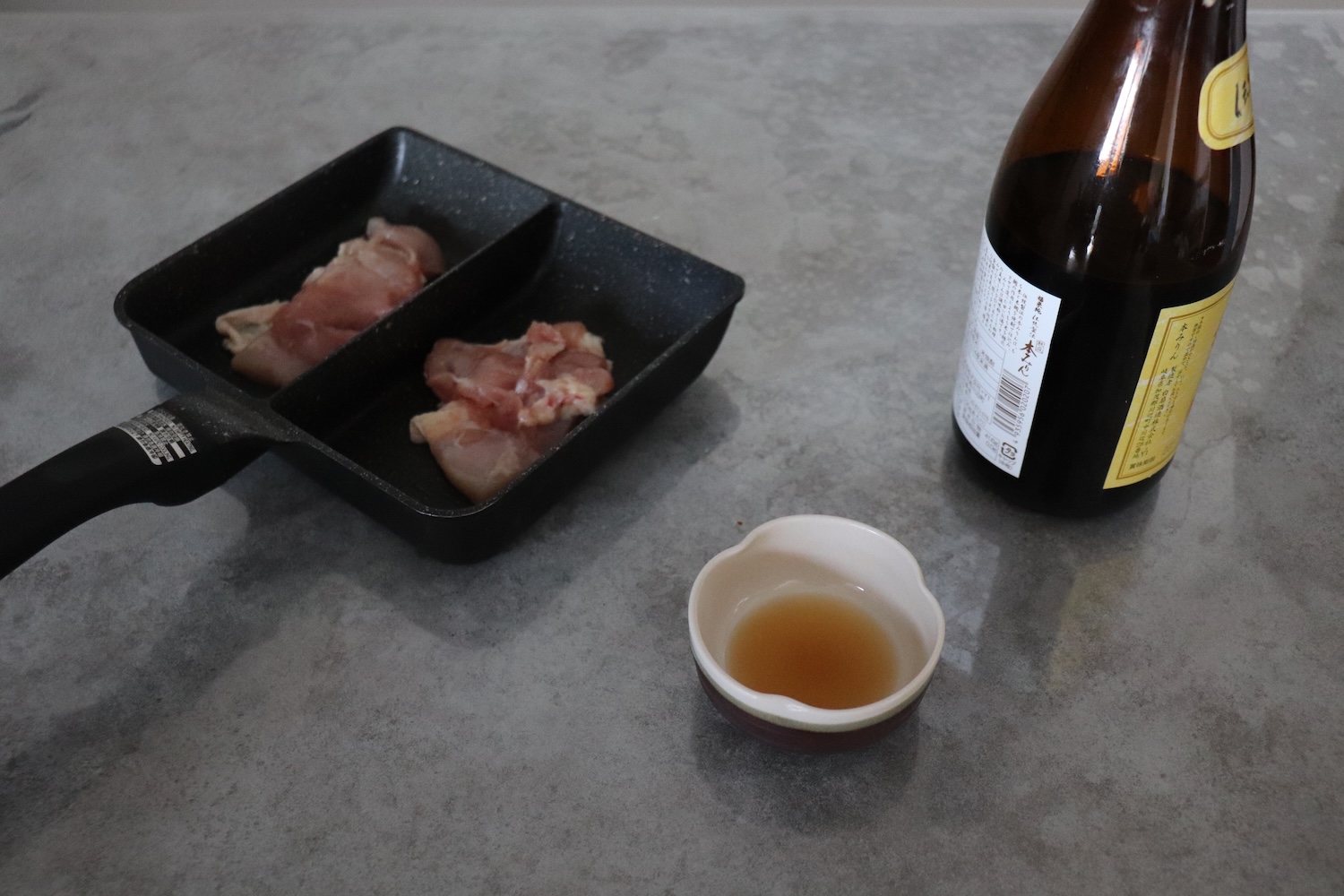
Mirin is often introduced as a “sweet rice wine,” usually mentioned alongside teriyaki sauce or Japanese cooking.
That description is not wrong.
Yet it is incomplete.
In Japanese kitchens, mirin is rarely treated as sweetness alone. It exists in relation to heat, to time and to the ingredient it meets.
Before looking at teriyaki,
it helps to pause briefly on what mirin is.
Mirin is a traditional Japanese fermented seasoning made from rice, koji, and alcohol.
Through fermentation,
starch slowly becomes sweetness—
soft, layered, and quiet.
A more detailed explanation of mirin
and its types can be found here:
https://health.wa-connecty.com/wahe/?p=1014
This Journal entry does not approach mirin through a recipe.
It looks instead at timing—
at when mirin enters the pan—
and what changes when everything else stays the same.
Only mirin, soy sauce,
and chicken thigh were used.
Why Mirin Matters in Teriyaki Sauce
Teriyaki is widely known,
yet often reduced to a single image:
a glossy, sweet sauce applied at the end.
In Japanese cooking, teriyaki is less fixed.
It is not only a sauce, but a process—
one shaped by heat and by when flavor is allowed to appear.
Mirin matters here as part of the teriyaki mixture.
The mirin–soy sauce combination does not behave all at once.
It responds differently depending on when it meets heat and the ingredient.
To understand mirin within teriyaki, knowing the ingredients is not enough.
Attention has to be given to when the mirin–soy sauce mixture enters the heat.
Setting the Observation: Mirin, Teriyaki Sauce, and Heat
This was not a controlled experiment.
It was a simple kitchen observation.
The ingredients were intentionally few:
- Chicken thigh
- Mirin
- Soy sauce
No sugar. No sake.
No added seasoning.
Heat level, pan, and cooking environment remained unchanged.
Only one thing moved:
the moment the mirin and soy sauce entered the pan.
With that single shift, the behavior of the mirin–soy sauce mixture became easier to notice.
Adding Mirin Before Cooking: Teriyaki Sauce Meets Heat Early
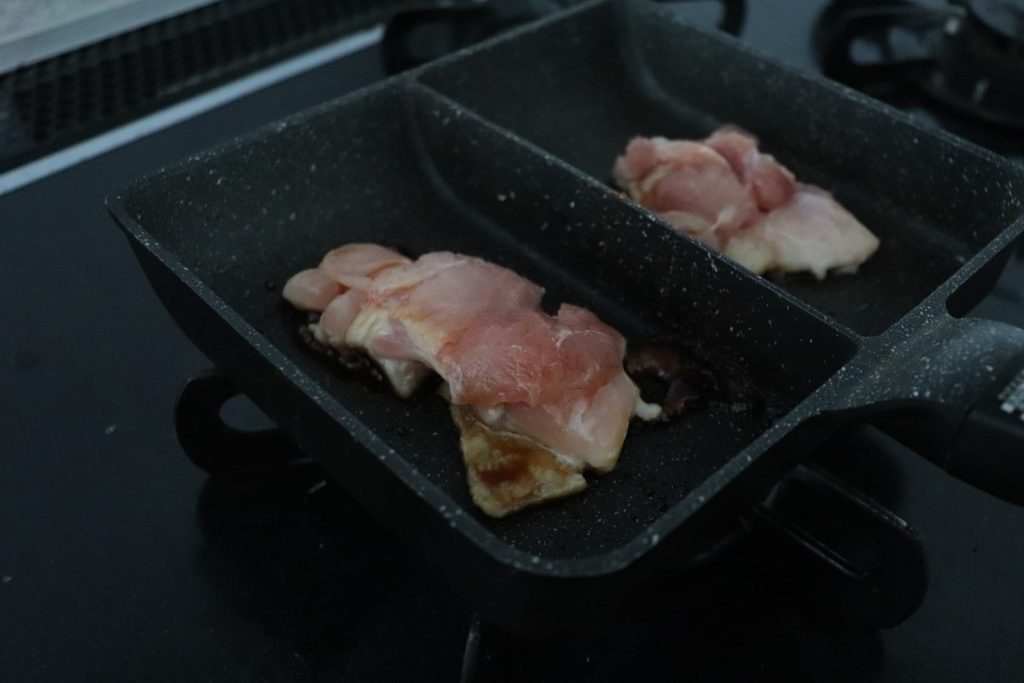
In the first observation, mirin and soy sauce were added before cooking.
The chicken and the sauce warmed together from the beginning.
The surface browned quickly.
The roasted aroma arrived early—
almost too early.
At the first bite, flavor was clear.
Then, as chewing continued, it thinned.
The texture felt firmer, the fibers more present.
Heat lingered longer than sweetness.
Adding Mirin Near the End: Teriyaki Sauce as a Finish
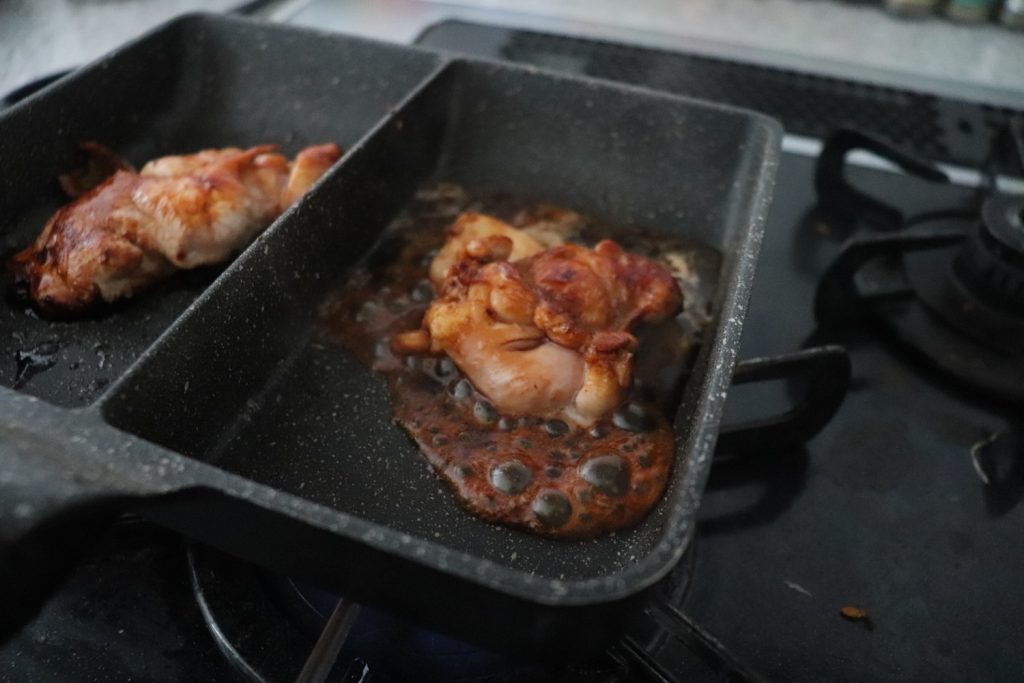
In the second observation, the chicken was cooked almost completely before mirin and soy sauce were added.
The glaze formed quickly,
without harsh browning.
The chicken felt softer.
Sweetness and roasted notes did not stay on the surface.
They remained through chewing.
With each bite,
flavor continued rather than faded.
Choosing When Mirin Enters the Pan
The ingredients did not change.
Only the timing of the mirin–
soy sauce mixture did.
Early,
the flavor arrives first—and leaves early.
Later,
it arrives quietly—and stays.
No rule appears here.
Only a difference.
In this observation, changing the timing revealed different expressions of the mirin–soy sauce mixture.
Across Japanese fermentation,
flavor is rarely placed all at once.
It is allowed to emerge, gradually,
through heat and restraint.
Those who are drawn to this way of seeing—where cooking is observation rather than instruction—may find resonance in our fermentation letters, where similar moments are quietly gathered.
Conclusion: Continuing the Observation
This Journal entry does not offer a method. It offers attention.
By changing only when the mirin–
soy sauce mixture entered the pan,
the same ingredients produced different experiences at the table.
Mirin is one seasoning.
Yet through it,
a larger approach becomes visible—
one that values timing as much as technique.
Our programs are designed for those who want to understand Japanese fermentation more deeply—through observation, context, and the reasoning that lives beneath flavor, rather than recipes alone.
For those who wish to continue exploring in that way, we invite you to step into our fermentation study programs and short-term classes, cooking class and Japanese tea pairing with fermentation cuisine in Japan.
Mirin continues to change.
Only the moment of entry decides how.
No responses yet