
Vinegar often feels harder to use than other seasonings.
Even in small amounts, it can dominate a dish.
Sometimes it sharpens flavors; other times it flattens them.
The same vinegar, used with care one day,
can feel misplaced the next.
Because of this unpredictability,
vinegar is often treated cautiously—or avoided altogether.
It is labeled as “strong,” “difficult,” or “easy to overdo.”
This Journal entry does not aim to solve that difficulty.
Instead, it records two simple moments of
using vinegar and observes what actually happens—
without deciding which is better.
Two Moments, One Vinegar
In both moments, the same vinegar is used.
The seasoning is intentionally simple: vinegar, oil, and salt.
Nothing else changes.
The only difference is when the vinegar enters the dish.
What follows are observations, not conclusions.
Acidity After Heating
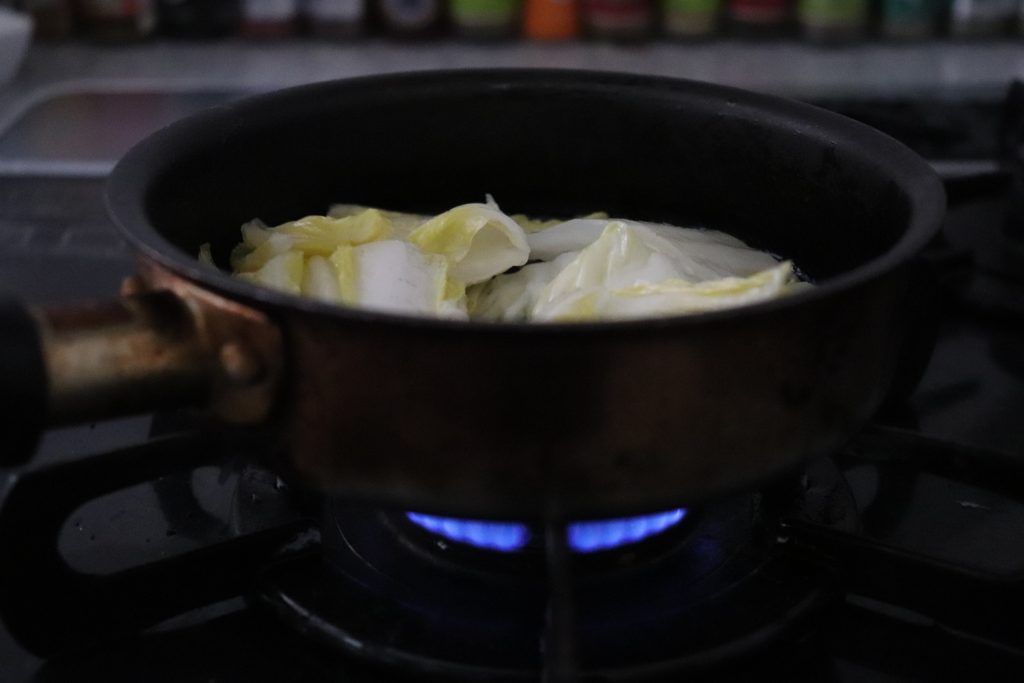
After heating, the aroma is subtle.
Only when the food is brought close does a faint scent appear,
and even then, acidity itself is not clearly identifiable.
Once in the mouth, there is a short delay.
For the first two or three seconds,
no distinct taste stands out.
Then a sensation emerges—not sharpness, not sourness,
but a quiet sense of clarity.
It does not announce itself as “acid.”
What remains is a clean finish,
as if something has been cleared rather than added.
Acidity Added at the End
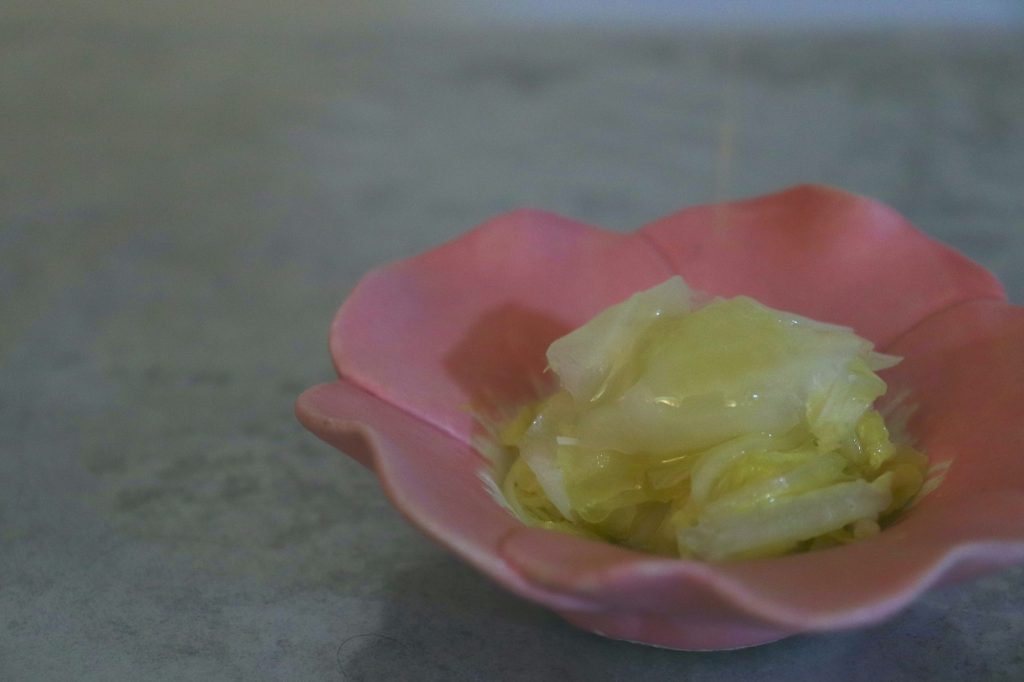
When without heating,
the aroma appears only when the food is brought close.
What reaches the nose is not acidity alone,
but a blended scent—acid and oil together.
In the mouth, the experience is less fixed.
Depending on the bite, the balance
between the ingredient and the seasoning shifts.
At times, a sharp sourness appears immediately.
At other times, it does not appear at all.
As chewing continues, the sharpness may surface—
or it may remain absent.
The acidity does not behave the same way each time.
It comes and goes, responding to the moment
rather than settling into a single role.
What This Asks of the Cook
These observations do not suggest a correct method.
They ask something quieter.
They ask the cook to stop expecting vinegar
to behave consistently.
To stop treating acidity as
a fixed flavor that must always “work.”
Vinegar does not simply add sourness.
It shifts position—
sometimes dissolving into the background,
sometimes stepping forward unexpectedly.
Using vinegar, then,
is less about control and more about attention.
Noticing when it disappears.
Noticing when it interrupts.
Accepting that it may do neither in a predictable way.
Acidity That Moves
Acidity is not a static taste.
It moves—through heat, through timing,
through the act of eating itself.
Rather than mastering vinegar,
this Journal invites you to stay with it a little longer.
To observe how it behaves, without rushing to correct it.
If you would like to continue this kind of observation
—not only through reading,
but through cooking and tasting together—
you are welcome to explore our fermentation-focused
culinary experiences and study programs.
And if you would like to receive future Journal entries as
they are written, you can subscribe to our newsletter below.
Each issue continues this quiet practice of noticing
how fermented seasonings behave, one moment at a time.
No responses yet